Physically-consistent Robotic Inertial and Motion Estimation for Legged and Humanoid Robots

Jiarong Kang1, Kunzhao Ren1, Tao Pang, and Xiaobin Xiong1,2
1University of Wisconsin--Madison, WI, USA 2Shanghai Innovation Institute, Shanghai, China

Accepted to Robotics: Science and Systems (RSS) 2026

Abstract

Humanoid and legged robots interact with the environment through intermittent contacts, making accurate motion estimation fundamentally dependent on reasoning about contact dynamics. However, standard sensing pipelines—whether based on onboard proprioception with Extended Kalman Filters (EKFs) or external motion capture systems—recover only kinematics, while contact forces, contact timing, and inertial parameters remain unobserved. As a result, purely kinematic reconstructions often violate rigid-body dynamics, particularly during contact-rich motions.

To enable accurate motion estimation from onboard kinematics in real-world deployment, we propose PRIME (Physically-consistent Robotic Inertial and Motion Estimation), a Maximum A Posteriori formulation that refines measured kinematics and actuator commands into a dynamically consistent trajectory while jointly estimating frictional contact forces and physically consistent inertial parameters. Our approach incorporates differentiable contact dynamics with smoothed complementarity constraints and an Anitescu-style friction model, yielding a smooth optimization problem that remains stable across contact transitions.

We evaluate PRIME on contact-rich locomotion with quadrupedal robots and the Unitree G1 humanoid, demonstrating improved trajectory consistency and accurate inertial parameter identification. Beyond improving model-based estimation and control with calibrated inertial parameters, PRIME produces force- and contact-annotated motion reconstructions from real robots in deployment, which can be used to provide high-quality data for downstream learning applications, including large-scale behavior modeling and robot foundation models.
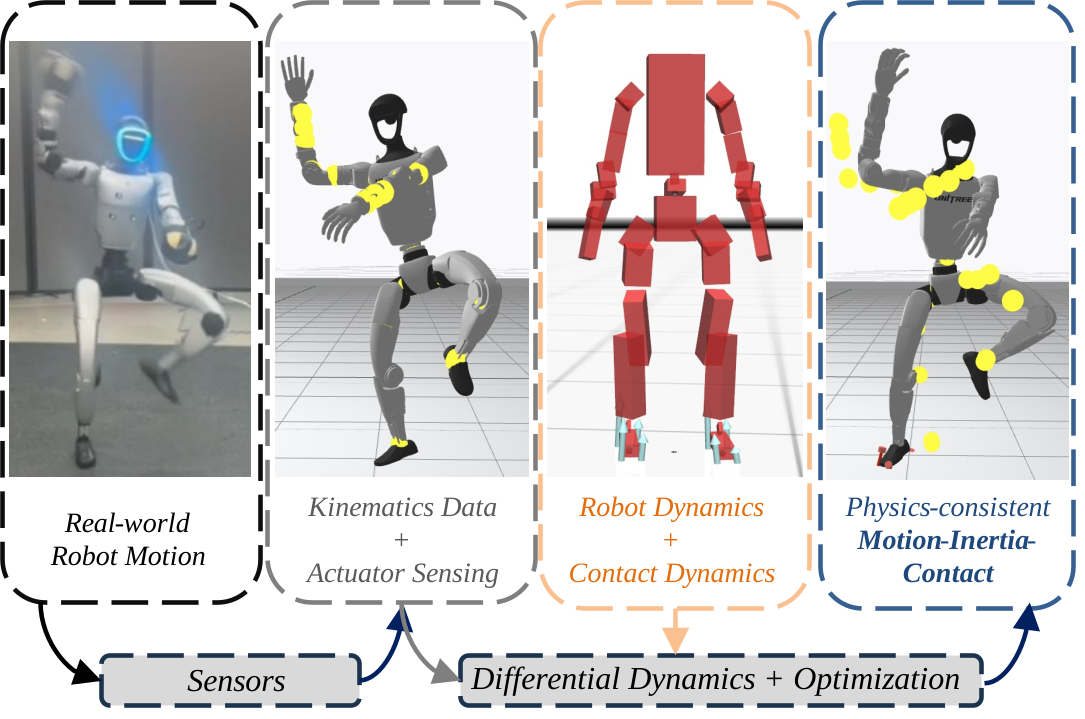
PRIME overview figure.

Framework Overview

PRIME uses differentiable contact dynamics within a Maximum A Posteriori framework to jointly estimate physics-consistent motion trajectories, inertial parameters, and contact from real robot data.
PRIME reconstructs long-horizon kinematics measurements into dynamically consistent motion with contact annotations.

Go2 Hardware

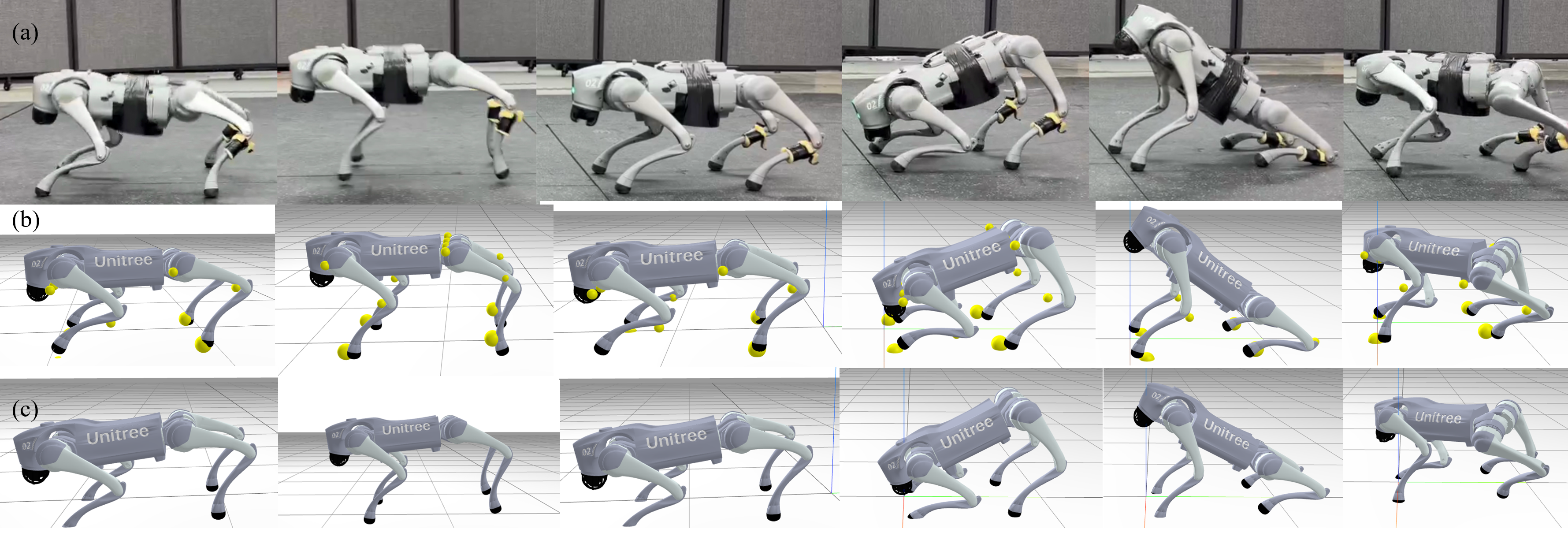
Go2 motion estimation and inertia identification results.

Quadrupedal Go2 results show PRIME reconstructing dynamically consistent motion and contact during diverse locomotion with a 4.6 kg payload attached beneath the torso.

G1 Hardware

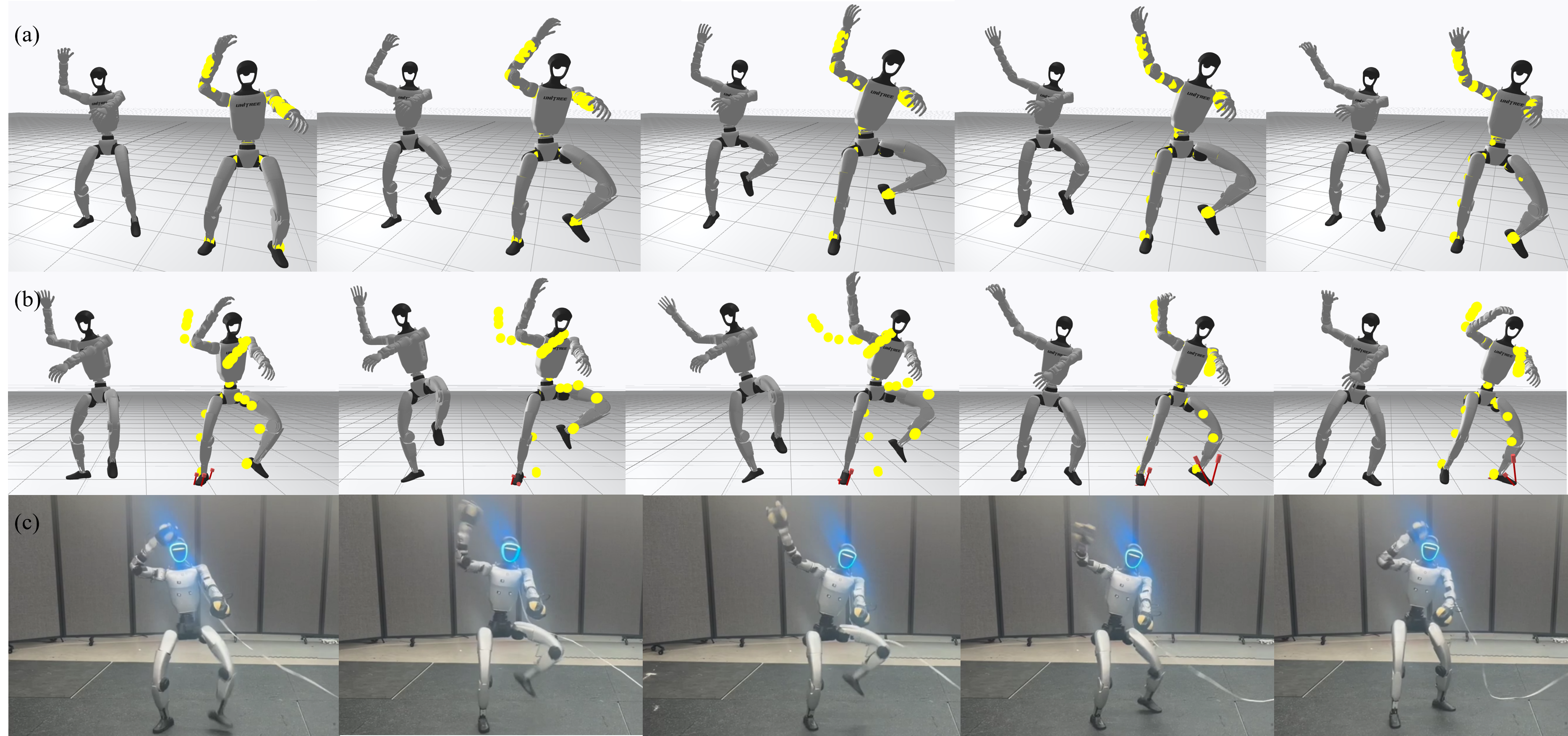
Unitree G1 humanoid reconstruction results.

Real and simulated G1 experiments illustrate PRIME correcting contact-inconsistent kinematics and recovering physically consistent whole-body motion.

Go2 Simulation

G1 Simulation

PRIME performs accurate inertia parameter identification during reconstruction, with consistent numerical evaluation across robots.

Quadruped Go2 Torso Identification

\(\mathrm{Parameter}\) \(\mathrm{Original}\)
\(\mathrm{Values}\)
\(\mathrm{Simulation}\)
\(m\ (+3\,\mathrm{kg})\)
\(\mathrm{Simulation}\)
\(c_z\ (-0.1\,\mathrm{m})\)
\(\mathrm{Real\mbox{-}world}\)
\(m\ (+4.6\,\mathrm{kg})\)
\(m\ [\mathrm{kg}]\) \(6.927\) \(9.975\) \(6.865\) \(11.740\)
\(c_x\ [\mathrm{m}]\) \(0.022\) \(0.034\) \(0.242\) \(0.037\)
\(c_y\ [\mathrm{m}]\) \(0.000\) \(0.138\) \(0.089\) \(0.004\)
\(c_z\ [\mathrm{m}]\) \(-0.005\) \(-0.012\) \(-0.105\) \(-0.013\)
\(I_{xx}\) \(0.025\) \(0.033\) \(0.024\) \(0.014\)
\(I_{yy}\) \(0.098\) \(0.138\) \(0.089\) \(0.274\)
\(I_{zz}\) \(0.108\) \(0.150\) \(0.097\) \(0.274\)

Humanoid G1 Torso Identification

\(\mathrm{Parameter}\) \(\mathrm{Original}\) \(\mathrm{Values}\) \(\mathrm{Real\mbox{-}world}\) \(\mathit{Total\ weight}\ (+2.91\,\mathrm{kg})\)
\(m\ [\mathrm{kg}]\) \(9.60\) \(13.02\)
\(c_x\ [\mathrm{m}]\) \(0.00332\) \(0.03186\)
\(c_y\ [\mathrm{m}]\) \(0.0003\) \(-0.0165\)
\(c_z\ [\mathrm{m}]\) \(0.1798\) \(0.1775\)
\(I_{xx}\) \(0.1241\) \(0.2669\)
\(I_{yy}\) \(0.1121\) \(0.3075\)
\(I_{zz}\) \(0.0327\) \(0.1097\)

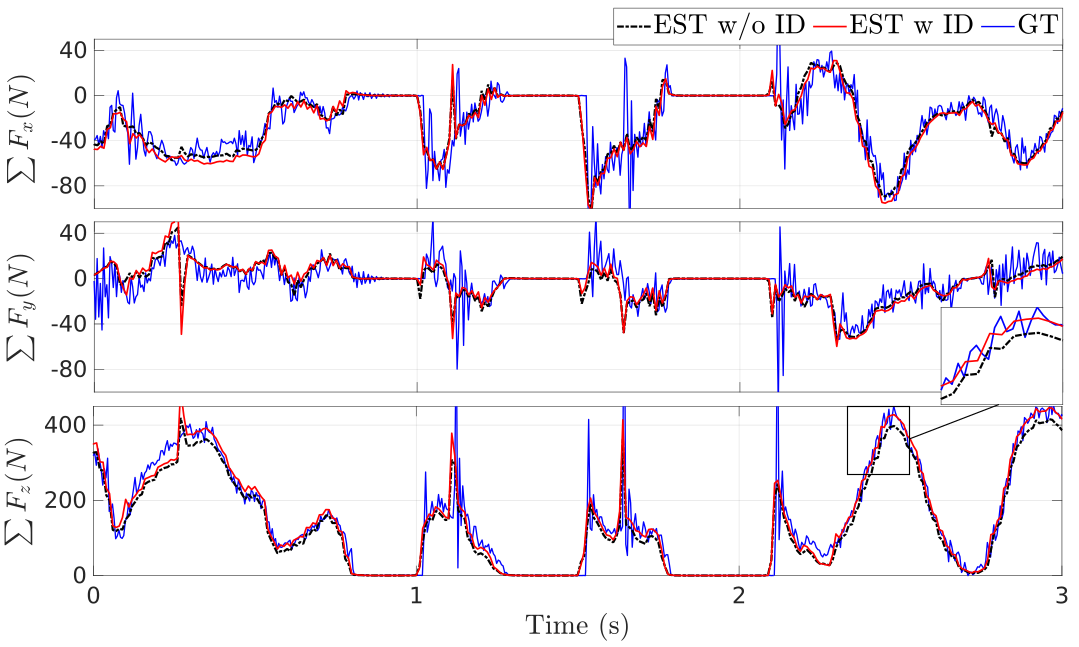
With accurate motion reconstruction and identification, PRIME achieves accurate force estimation against real-world force-plate measurements.

G1 Hardware with Force Plate Comparison

Force comparison results for G1 with identification.

RMSEs and Cost on G1 Hardware

\(\mathrm{Estimation}\)
\(\mathrm{Metric}\)
\(\mathbf{With\ ID}\) \(\mathrm{W/O\ ID}\)
\(\mathrm{RMSE}_F\ [\mathrm{N}]\) \(24.486\) \(26.141\)
\(\mathrm{Cost}\ [\times 10^3]\) \(1.016\) \(1.880\)

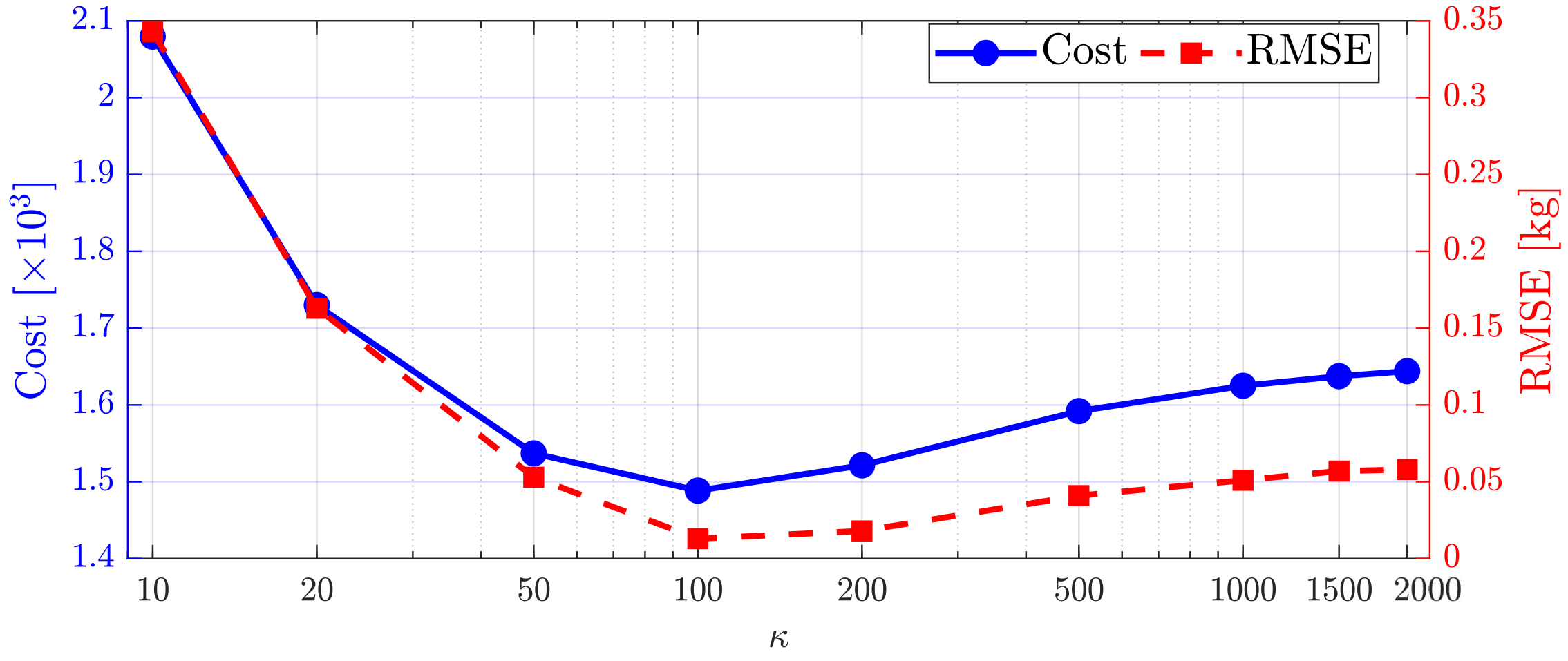
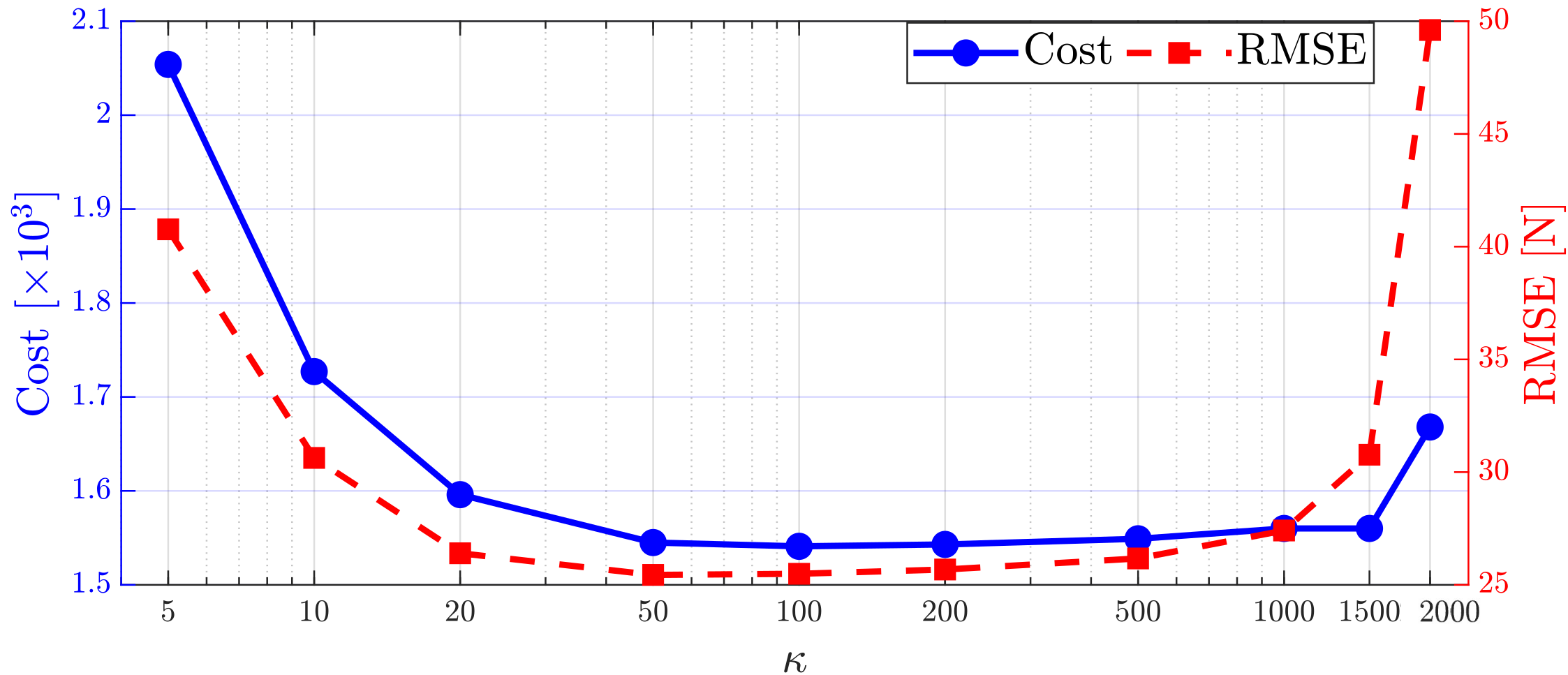
Analytic smoothing improves optimization convergence while accommodating noise and uncertainty, which in turn supports more reliable identification and F/T-sensorless force estimation.

Effect of smoothing parameter on identified mass and optimization cost.
Effect of smoothing parameter on force RMSE and optimization cost.

BibTeX

@article{prime2026,
  title        = {PRIME: Physically-consistent Robotic Inertial and Motion Estimation for Legged and Humanoid Robots},
  author       = {Kang, Jiarong and Ren, Kunzhao and Pang, Tao and Xiong, Xiaobin},
  journal      = {Preprint},
  year         = {2026}
}